Product Development
One team from the first conversation to the software in production.
Most products fail somewhere in the handoffs — between the person who scoped it, the one who designed it, the one who built the app, the one who built the backend and the one meant to keep it running. We do all of it, so there are no handoffs to fall through.
You can arrive with an idea, a problem you keep hitting, or a half-built product that stalled. You do not need a specification.
What that covers
- check_circle Product discovery and requirement analysis
- check_circle Technical feasibility and approach
- check_circle System architecture and data modelling
- check_circle UI and UX design
- check_circle Web application development
- check_circle Mobile application development
- check_circle Backend engineering and APIs
- check_circle Databases and integrations
- check_circle Cloud infrastructure and deployment
- check_circle Testing and production readiness
- check_circle Monitoring, maintenance and support
- check_circle Iteration once real users arrive
Not every project includes every item. We scope to what the problem needs.
From problem to production, and then onwards
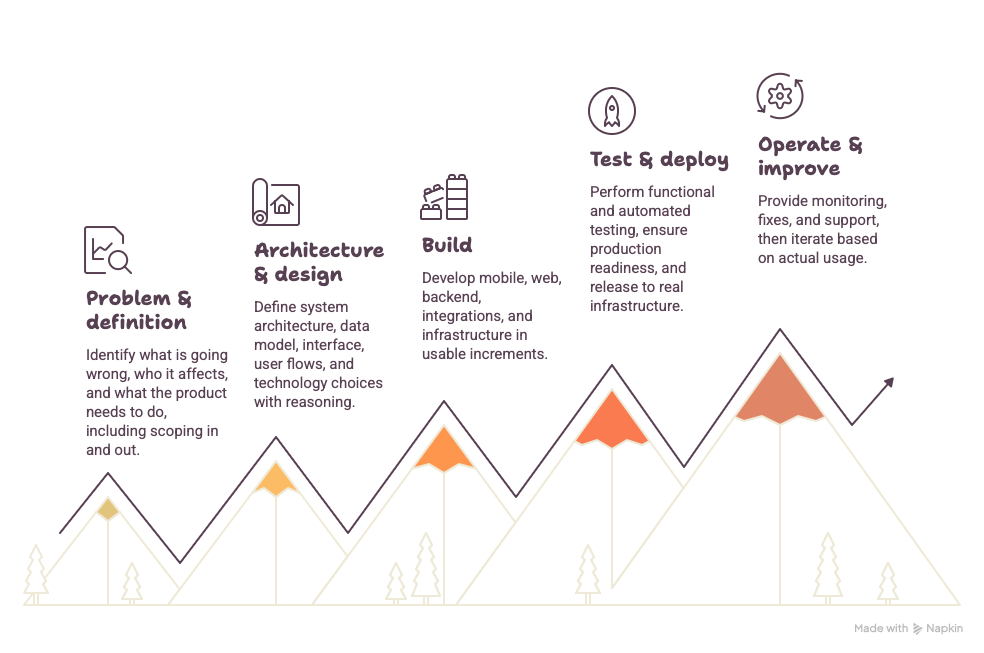
Each stage produces something you can look at and disagree with, rather than a status update.
-
01
Problem & definition
What's actually going wrong, who it affects, and what the product needs to do about it. Scope in, and just as importantly, scope out.
-
02
Architecture & design
System architecture, data model, interface and user flows — plus the technology choices, with the reasoning attached.
-
03
Build
Mobile, web, backend, integrations and infrastructure, in increments you can use rather than a single reveal at the end.
-
04
Test & deploy
Functional testing, automated tests where they pay for themselves, production readiness, and release to real infrastructure.
-
05
Operate & improve
Monitoring, fixes and support — then the next round of work, driven by what actual usage reveals.
If you're not an engineer
You don't need to speak engineering to work with us.
You understand your business, your customers and the problem. We understand how to build software. Bridging those two is our job, not yours.
In practice that means we won't answer a question about cost or timeline with a diagram, and we won't let a technical decision go past you unexplained because it seemed easier that way. When there's a real choice to make, we'll lay out the options, what each one costs you later, and what we'd recommend.
Explaining clearly isn't the same as talking down. You'll get the actual reasoning, in words that carry it.
Questions in your language
The first conversations are about customers, operations and constraints — not frameworks.
Decisions in the open
What we picked, what we didn't, and what it means for cost, timeline and what's possible later.
Progress you can see
Working software at intervals, not percentage-complete numbers on a report.
No dependency by design
Standard technologies and clear architecture, so another team could pick it up if you ever need them to.
Appropriate engineering, not maximum engineering
Every piece of complexity in a system is something that has to be understood, paid for and maintained. We add it when the problem earns it.
Instead of
Microservices from day one
Often better
A well-structured single application, split later at the seams that actually appear under load.
Instead of
An AI feature because AI is expected
Often better
Deterministic software where it produces a correct answer every time — and AI where it genuinely does better.
Instead of
A custom build for everything
Often better
An integration with a tool you already pay for, when that honestly solves it.
None of these are rules. They're the conversations worth having before the decision is baked into the codebase.
We've done this for our own products too
TraceOn is a product we defined, built, deployed and now operate: a Flutter app doing offline attendance capture and background location tracking, a React admin portal, and a NestJS and PostgreSQL backend enforcing a permission model that follows the customer's org chart.
It's the clearest example of what end-to-end means here — including the parts that only show up once real users are on it.
Related
Common questions
Do I need a technical co-founder to work with Appseed?
expand_more
No. Many of the people we work with are not engineers. You bring the understanding of the business and the customer; we handle the engineering and explain the decisions in language you can act on.
Do you always build every part of the product?
expand_more
No. Some projects need the mobile app, backend, database and infrastructure together; others need one piece added to what already exists. We scope to the problem, not to a package.
How do we start if I don't have a specification?
expand_more
That's the normal case. We start with the problem, the users and the constraints, and produce a product definition and technical approach from there before any code is written.
Tell us what you're trying to build.
An idea, a problem, or a product that stalled halfway. We'll start by understanding it.